Blog · 3 min read
Is Courtyard Legit? A Close Look at the Biggest Digital Pack Platform
Courtyard is venture-backed and pays out in real dollars, but its card values come from its own algorithm. Our score, the pack math and the complaints.
By the PackRipper editors · Published
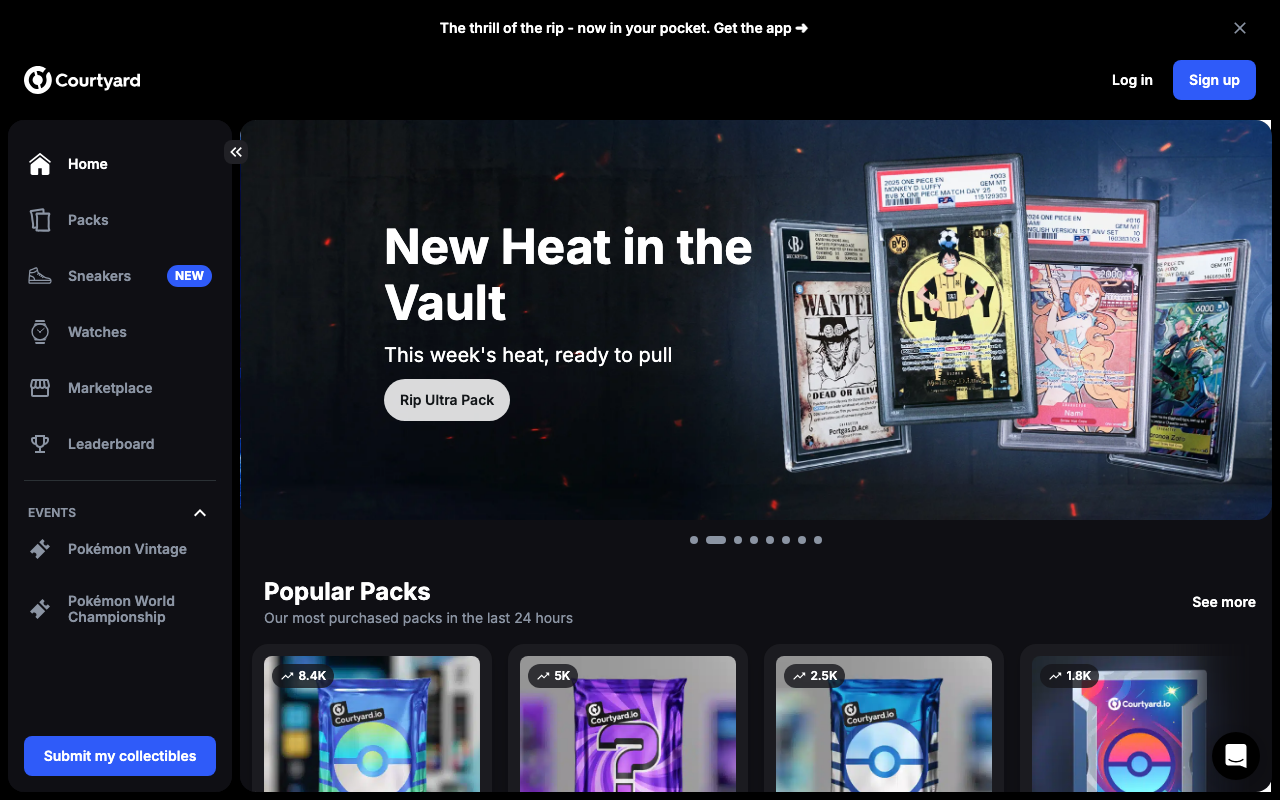
Courtyard is legit. It’s a venture-backed US company (it raised a $30M Series A in 2025), it holds real graded cards in an insured vault in Delaware, and it pays out in actual dollars through debit card, PayPal, Venmo and bank transfer. If your question is “will I get scammed,” the answer is almost certainly no.
The more useful question is whether the packs are a good deal, and that one’s messier.
What you’re actually buying
Courtyard calls its packs “vending machines.” You pay, you get a graded card (Pokémon, sports, One Piece, and also some watches and sneakers), and the card sits in Courtyard’s vault. From there you can hold it, ship it, or take the instant buyback, which is usually around 90% of what Courtyard says the card is worth. The buyback is paid as USDC that you can withdraw, and you get seven days to decide.
Packs start at $25.
Let’s do the math on a $25 pack
This is one thing Courtyard does better than most. Each pack page shows how the values are spread out. On the $25 Pokémon Starter pack, Courtyard’s own panel puts the average item value at $24. Most pulls land between $17 and $25, and only about 2% are worth $50 or more.
So an average pull is worth a bit less than you paid. Take the 90% buyback on a $24 card and you get about $21.60 back. Do that over and over and you lose a little under 14% each time on average. That’s not a scam. It’s just how this works, and Courtyard is more upfront about it than a lot of its competitors.
A newsletter that tested a much pricier $499 pack reported buyback offers at 80 to 90% of recent sales, and odds on the chase cards that were sometimes below 1%.
Where people get frustrated
Valuations. Courtyard sets card values with its own pricing algorithm. When users think a card is worth more than Courtyard says, there’s no outside referee. This is the single most common complaint in its low-star reviews.
Surprise ID checks. Debit and Venmo withdrawals are advertised as arriving in minutes, but several people say their first withdrawal was held for identity verification they didn’t see coming. One review also mentions a 15% withdrawal fee. We’ve only seen that once, so treat it as a single report, not a confirmed policy.
Shipping takes a while. Courtyard quotes up to 10 business days to process plus FedEx transit. Two recent reviewers put the total at about three weeks. Shipping fees can also be steep compared with the value of a mid-range card.
BBB. Courtyard has an F rating, with 16 complaints closed over three years.
Ratings, all over the place
App Store: 4.6 from about 8,300 ratings. Google Play: 4.4 from about 3,200. Trustpilot: 3.7 from 797, with 52% five-star and 23% one-star. Courtyard actively invites Trustpilot reviews, and one page we checked in mid-September showed a same-day burst of short five-star reviews. None of that is shady on its own, but it’s why we average across sources instead of trusting any single one.
How it scores
Courtyard lands at 5.9 out of 10. The biggest boost is Reputation at 8.1: a 4.2★ average across three review sites and over 12,000 ratings, which is enough volume to count in full. Fairness is the weak spot at 2.5, because there’s no provably-fair system and odds are shown as value ranges, not per-card chances. Value is strong at 8.0 thanks to the 90% buyback. Payouts is 4.7, Experience 6.0 and Support 5.0.
A 5.9 might sound middling, but we rank 39 platforms and nobody gets above the low sixes, so Courtyard is in the top group. The scores are a comparison, not a pass or fail.
Who it’s for
Courtyard makes sense if you want graded cards, you like the idea of an insured vault, and you want to cash out in normal money. Go in knowing the average pack loses a bit, and read the value distribution before you buy.
If you’re weighing it against the others, we have Courtyard vs Arena Club, GameStop Power Packs vs Courtyard and Rips by Triumph vs Courtyard. There’s also a list of Courtyard alternatives. Sources for every number are on the Courtyard listing. You must be 18 or older.
Keep digging

The biggest name in digital 'vending machine' packs: graded Pokémon, sports and One Piece cards (plus watches and sneakers) held in a Delaware vault, with ~90% instant buyback and fiat cash-outs.
More from the blog
- Are GameStop Power Packs Worth It? The Real Buyback Is 84.6%
GameStop Power Packs sell $25 packs of PSA-graded cards. The buyback looks like 90%, but the fee brings it to 84.6%. Our score and the math.
- Is Arena Club Legit? Derek Jeter's Slab Packs, Scored
Arena Club has the clearest buyback terms we found and a Derek Jeter pedigree. So why is its Trustpilot score 1.7? Our breakdown and score.
- Is HypeDrop Legit? The Mystery Box Veteran, Checked
HypeDrop has one of the best documented provably-fair systems around, but cash-outs are crypto only and account locks top its complaints. Our score.